
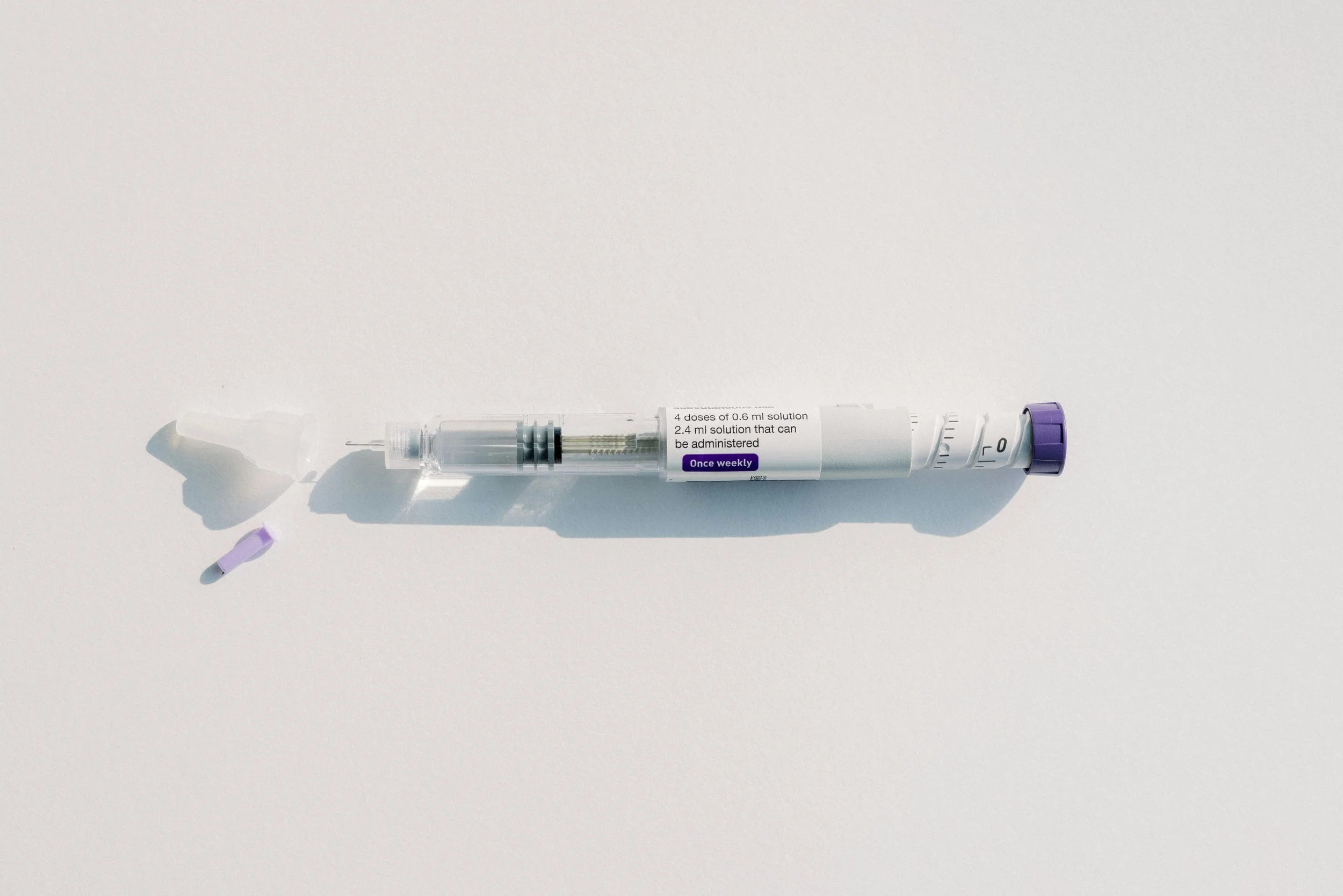
It's estimated that 11% of the US population is on a GLP-1 medication, to say these have swept across America like a tornado would be an understatement. And every day, I have patients experiencing PMOS, MCAS, weight gain, infertility or just plain old perimenopause, who come to me and want to talk about the feasibility of using a GLP-1 medication to feel better.
And it does seem like these medications are making a lot of people feel better, and they are helping people to lose weight and they are reducing inflammation. And even though these are relatively new medications, some of this is backed up by some fairly robust science! From PMOS to MCAS to infertility, these medications are showing a lot of promise across a lot of spectrums and I'll discuss that below.
But it's not all hearts and rainbows, and what I find isn't often being communicated properly is HOW to use the GLP-1 medication alongside a robust lifestyle plan, so that any weight you do lose, any inflammation that is lowered, stays that way, when you decide to come off the drug.
Why You Need a Long-Term Plan Before Starting a GLP-1
When considering the use of a medication such as these, we HAVE to have a long-term lens on it, this can't be about fitting into a dress for an event in 8 months, or getting back to pre-baby weight as quickly as possible. It can't even be about locking in for 6 months to lower a specific blood marker so you don't get pressure to go on a medication for a chronic condition (this happens a lot with blood pressure and cholesterol, people think if they can just lose 15 lbs their doctor will stop hounding them to go on a medication).
These medications need to be approached with the care and thoughtfulness of any long-term medication, and that includes understanding and embracing the needed lifestyle modifications that will need to be on board for long-term success.
Because, quickly, let me tell you what happens if you go through a speed round of weight loss, even 5 or 10 lbs, and then gain it back 6 months later.
What Happens When You Start to Lose Weight Fast on a GLP-1: A Cautionary Tale
You weigh 160 pounds. You are a bridesmaid in your best friend's wedding in 8 months and you have 140 pounds in your head as your goal weight. Everyone is taking GLP-1s, so you go on one, understanding that it'll really dial down the food noise and you won't overeat as much. It works, you lose 15 lbs pretty easily in 4 months, you keep taking the dose up and you keep losing. You got your medications through an online service and they didn't provide much guidance on food or exercise, but it doesn't matter because you just want to be skinny for this wedding and then you'll come off of it, it's too expensive anyway.
You aren't working out really, you go for walks and sometimes do an F45 class. You're basically eating what you want, just less of it, some days you don't eat much at all. And your stomach is a bit flared, so you're sticking with blander things like pasta and cereal. You're pretty tired and you've noticed that yes, you're thinner, but you've also got a lot of loose skin around your middle. No matter, 140 is the goal and onward we go.
After the wedding, you come off the medication. Your appetite comes back pretty quickly, because you never did any work to retrain yourself in how to eat when you had the control mechanism (the med) in place. You find yourself binging more, though you are trying to keep it under control. The weight comes back on, quickly. And you feel super puffy and bloated too. You pass 160 and climb to 170, you're panicking now.
What has happened here? This is a classic case of GLP-1 use gone wrong. The patient has lost rapid weight, but "weight" is not only made up of fat. Muscle is "weight" too. And our muscles help maintain our metabolic rate (the rate at which we burn calories).
Less muscle = lower metabolic rate/less calories burned per day.
This means, your body has come out of this GLP-1 phase with less ability to burn calories than it had before, because you lost so much muscle along with some fat. Which means you can't go back to eating the way you did before, because that calorie load is now far too high for your metabolism.
Your ability to maintain even the body you had before, whatever that was, just got harder. To say nothing of this new, skinnier, you.
But what could have happened instead? Realistically, this patient could have had the same 8 month runway to lose a few pounds before the wedding. She could have worked with someone who would have helped her understand what her goal calories were every day, what she needed to eat to lose weight, but not lose it too fast. She could have understood what type of movement she needed to build in, just to maintain her muscle mass. And she could have walked into that wedding 12-15 pounds lighter, but looking like a hot unit because she wouldn't have lost so much muscle (which makes you look "skinny fat", as it is called). Maybe, with the right nutrition and training plan, she would have gained some muscle AND lost fat which is… as we all know…the holy grail.
This is where utilizing a short-term coaching program like mine (see below for more information) would have been brilliant. Temporary investment of time and money for long term results and success. Priceless.
Ok, long story long on that one... sorry. But I wanted to illustrate the dangers in misuse.
But this article is also about the benefits of these medications, and the science that backs it up. So let's dive into it:
How GLP-1 Medications Reduce Inflammation

Bit of a catch-all phrase, but starting here covers the most ground. GLP-1 medications have been shown to be powerful anti-inflammatories in studies. One of the mechanisms through which this happens is through the improved insulin signaling and reduction of fasting insulin that these medications produce.
Out of control blood sugar and insulin response is driving a ton of inflammation in our society right now. 12% of the US population has diabetes and 43% (!!!) has what can be called prediabetes, but many of those people have no idea that they are prediabetic.
Improving insulin signaling through use of a GLP-1 medication can be a real game changer here. One study showed that a prediabetic person taking a GLP-1 medication had a 73% lower risk of progressing to diabetes, along with improvements in HbA1C, BMI and other markers. Many of them eventually moved into "normal" range on their bloodwork.
These medications are also showing lower C-Reactive Protein (CRP) levels. CRP is a blood marker that gives you a picture of the vascular inflammation in your body. Increased CRP is serious and unfortunately, becomes more common as we age.
One study found that CRP declined by as much as 38%, alongside weight loss, but further evaluation of the data found that there was still a decrease in CRP independent of the weight loss itself. THIS is where we can really see where GLP-1s are inflammation fighters even without a weight loss component (which lends itself to a discussion on micro-dosing, which I will address below).
GLP-1s and PMOS (PCOS): Lowering Insulin-Driven Androgens
Reducing inflammation along these pathways has been shown to benefit women with PCOS (polycystic ovarian syndrome), now called PMOS (polyendocrine metabolic ovarian syndrome), as poor insulin signaling is one of the primary drivers of overproduction of androgens. Helping to improve that pathway can bring a lot of relief. There is some early-stage research that reinforces this as well.
GLP-1s and MCAS: Can They Calm Mast Cell Symptoms?
Gaining awareness in 2026 is a condition called MCAS (mast-cell activation syndrome). MCAS is a condition in which mast cells, immune cells found throughout connective tissue, skin, and mucosal surfaces, become abnormally reactive and release excessive amounts of histamine and other inflammatory mediators in response to triggers that wouldn't normally provoke a reaction, such as certain foods, temperature changes, stress, or exercise. This can produce a wide range of symptoms across multiple body systems at once, GI distress, flushing, hives, dizziness, brain fog, and anxiety among them, often making it difficult to pin down and easy to mistake for several unrelated conditions.
Interestingly, GLP-1s and their effect on MCAS has also been looked at, and again, the data was intriguing. In a group of mostly female, midlife suffers of MCAS who had had limited response to traditional treatment, starting a GLP-1 resulted in 89% of those in the study showing improvements in their symptoms. The theory of efficacy hinges on the fact that there are GLP-1 receptors on mast cells, and the medication downregulates the degranulation (reaction), resulting in less symptomology.
GLP-1 medications are also known to dampen other inflammatory markers in the body, beyond CRP, and many of those have interplay with MCAS, so there are other avenues of efficacy that researchers are exploring to further understand this process.
GLP-1s and Infertility: IVF Success Rates in Women with PMOS
In the infertility sphere, GLP-1s have been shown to improve pregnancy outcomes for obese women with PMOS undergoing IVF who had had a poor response to first line treatments. In a group of women taking a GLP-1 and metformin (commonly used for insulin sensitivity issues) vs. a group of women only taking metformin, the group with the GLP-1 had a pregnancy rate of almost 70%, while the metformin-only group was closer to 35%, with IVF. Those are impressive numbers. The data is less available for women without PMOS experiencing infertility, but hopefully we'll see some soon.
I want to wrap this epic novel (the Odyssey's got nothing on Jill) with a discussion around general metabolic health, what GLP-1s have to do with that, and how it pertains to midlife women specifically.
GLP-1s and Metabolic Health in Midlife Women
Metabolic health is driven by a number of factors, but one of the most important individual drivers of metabolic health is how much muscle mass someone is carrying. It is almost independent of whether their fat mass is also high, muscle mass is THAT important (i.e., it is metabolically better to be fat with lots of muscle than to be fat or skinny with very little muscle).

Speaking of fat, we have subcutaneous fat (the fat you can grab on the body) and we have visceral fat (the fat that wraps the organs, makes the abdomen hard and distended). Visceral fat is the fat we need to be concerned with, and the mid-life transition for women, where estrogen is declining, is when we see visceral fat begin to increase. Estrogen normally acts to suppress fat growth through the middle and encourage it in the hips and thighs instead. But as estrogen declines, this suppression through the middle vanishes. Visceral fat is highly inflammatory fat, it wraps the organs, and the signals it sends out are highly inflammatory to the body. And your body composition can seem to change without you gaining a single pound!
GLP-1 meds have been shown to reduce visceral fat. This is very important for women's long-term health. But they approach the body from one angle, HRT/MHT (hormone therapy) approaches it from another angle. And studies have shown that women on a GLP-1 who also take menopause hormone therapy have better results than those who do not.
So there are multiple ways to approach this issue, as you can see. And GLP-1 medications can be immensely helpful across a variety of inflammatory spectrums. Micro-dosing (taking between 10 and 15% of a regular dose) has been studied for MCAS, but not much else right now. Regular dosing is what has been most studied across the topics I discussed today.
Build the Foundation First: Lifestyle First, Medication Second
But regardless of the issue you are experiencing, whether it's PMOS, infertility or just plain old perimenopause weight gain, understanding that these medications are not to be used in isolation, but should be combined with a robust, manageable lifestyle plan in order to maximize muscle retention and set you up for success in the long term, is CRUCIAL.
I might go so far as to say that doing the lifestyle pieces, having those in place first, is MORE important than what dose or what type of GLP-1 you are on. Build the foundation first. The foundation is the habits.
If you would like to understand my GLP-1 coaching program, it's a 5 call series that will set you up with the lifestyle pieces you need for long-term success on, or off, a GLP-1 medication.
Frequently Asked Questions
Do GLP-1 medications actually reduce inflammation, or is that just from weight loss?
Both. GLP-1s improve insulin signaling and reduce fasting insulin, which is a major driver of inflammation on its own. Studies have also shown CRP declining independent of the weight loss itself, which is where we can really see GLP-1s working as inflammation fighters even without a weight loss component.
Can GLP-1s help with PMOS (PCOS)?
Yes. Poor insulin signaling is one of the primary drivers of over-production of androgen production in PCOS (now called PMOS). Helping to improve that pathway can bring a lot of relief, and there is early stage research that reinforces this.
What is MCAS, and why would a GLP-1 help with it?
MCAS (mast-cell activation syndrome) is a condition in which mast cells become abnormally reactive and release excessive histamine and other inflammatory mediators in response to triggers that wouldn't normally provoke a reaction, such as certain foods, temperature changes, stress, or exercise. There are GLP-1 receptors on mast cells, and the medication downregulates the degranulation (reaction), resulting in less symptomology. In one study, 89% of midlife MCAS sufferers with limited response to traditional treatment showed improvement after starting a GLP-1.
Do GLP-1s improve fertility outcomes?
For obese women with PMOS undergoing IVF, yes. One group taking a GLP-1 alongside metformin had a pregnancy rate of almost 70% with IVF, while the metformin-only group was closer to 35%. The data is less available for women without PMOS experiencing infertility.
What happens if I lose weight quickly on a GLP-1 without a lifestyle plan?
You risk losing muscle along with fat, which lowers your metabolic rate, meaning your body burns fewer calories per day. When you come off the medication and your appetite returns, you can't go back to eating the way you did before, because that calorie load is now far too high for your metabolism, which is exactly how the weight comes back on.
What's more important, the dose I'm on or my lifestyle habits?
The lifestyle habits. Doing the lifestyle pieces, having those in place first, is more important than what dose or what type of GLP-1 you are on. Build the foundation first. The foundation is the habits.
What is micro-dosing, and does it work for everything?
Micro-dosing means taking between 10 and 15% of a regular dose. It has been studied for MCAS, but not much else right now.
Should I combine a GLP-1 with hormone therapy during perimenopause or menopause?
That's a conversation for your doctor, but studies have shown that women on a GLP-1 who also take menopause hormone therapy have better results than those who do not, since GLP-1s and HRT/MHT approach the body from different angles.

We plan ahead to optimize outcomes—weddings, vacations, and job interviews. Why wouldn’t we plan to optimize our health before pregnancy? Don’t wait until you’re nauseous and exhausted to realize you need a strategy to eat better, sleep more, and stress less. Pregnancy can be an immense drain on the body, especially one that begins the journey stressed, undernourished, underslept, and exposed to a high level of environmental toxins.
Fertility Foundations is about controlling what we can control. Together, we’ll reduce lifestyle factors that may hold you back from feeling your best and do the work in advance so your body is prepared, resilient, and supported when pregnancy occurs.
This program is ideal for anyone on a fertility journey and is most effective if we have at least 3–6 months before you’d like conception to occur—but it’s also a powerful starting point if you’re earlier in the planning phase. Every change we make together supports your health, the health of your partner, and the health of your future child (and any children already in your home).
I’ll be with you every step of the way. We’ll identify the supports you need, tailor our calls to your priorities and unique situation, and adjust as life or plans shift. Entering pregnancy with a nourished, rested, and less inflamed body can make a meaningful difference in how you feel during pregnancy itself.
This program is not testing-dependent, though functional medicine testing can be added at standard rates if we decide it would be helpful. Testing is not included in the baseline program cost.
Program Details
Length
3.5 months
Meetings & Ongoing Support
Initial Setup Call:
One 60-minute onboarding sessionOngoing Calls:
Two calls per month for the first three months (45–60 minutes each)
One final call in month four (45–60 minutes)
Total Calls: 8
Email Support:
Weekly email support, as needed, for questions and ongoing guidance
Areas of Focus
We’ll focus on preparing your body—and your home—for pregnancy by improving nutrition and lifestyle factors that support fertility and a healthy conception or implantation. Topics may include:
Nutrition, optimized for fertility
Exercise
Stress management
Sleep
Environmental toxins
Supplements
Cycle regulation, if needed
Investment
$1,7000

Some of us may have a new friend in our lives. She’s… unpredictable. A bit chaotic. It doesn’t seem like she’s leaving anytime soon, and we need to figure out how to deal with her.
Meet Peri.
All jokes aside, perimenopause is often described as a time of hormonal chaos—and for many women, that’s exactly what it feels like. In today’s world of full-time jobs, aging parents, kids, school schedules, activities, and running a household, feeling “off” can sneak up on you. Perimenopause can begin 10 or more years before menopause, which is wildly inconvenient, considering these are often the years when women have the least amount of time to stop and figure out what the h*ll is going on.
Let me help.
Spend a little time with me each month, and together we’ll make sense of what’s happening in your body, reduce the overwhelm, and create a plan that actually fits your life.
If you’re in your 30s and suspect you’re just entering perimenopause, we’ll troubleshoot current symptoms, make sure the foundational lifestyle pieces are in place, and prepare you for what’s coming. If you’re in your 40s or 50s and right in the thick of it, we’ll evaluate what’s going on now, troubleshoot symptoms, refer out when appropriate, and focus on the strategies you need right now to feel better.
Areas of Focus
Our work together may include:
Understanding your current symptoms
Understanding the hormonal shifts occurring
Knowing what’s happening now and how things may change over time
Optimizing nutrition
Appropriate and effective exercise for this stage of life
Sleep hygiene
Hormone Replacement Therapy (HRT) education and discussion
Stress management strategies
How to minimize toxins
How to optimize supplements
This program is not testing-dependent. Functional Medicine testing can be added at standard rates if we decide it would be helpful. Testing is not included in the baseline program cost.
Program Details
Duration
3 months
Meetings & Support
Introductory Call:
One 60-minute onboarding sessionOngoing Calls:
Two calls per month for three months (45–60 minutes each)
Total Calls: 7
Email Support:
Weekly email support, as needed, for questions and ongoing guidance
Investment
$1,525
Would you rather do this with a friend? Check out the Add a Friend program instead!

This is the same Very Peri program—just designed for two people instead of one.
Do you have a friend who’s at the same stage of life? Move through the Very Peri coaching experience together and share the journey. You’ll receive the same education, guidance, and support as the one-person program, with the added benefit of a built-in accountability partner who truly gets it.
The topics, framework, and core content are exactly the same as the individual Very Peri program. The difference is that this option is structured to support two participants at once, with individual onboarding and expanded communication support for both people.
You’ll move through the same discussions, education, and practical guidance—together—while still receiving individualized support within the shared sessions.
How the Two-Person Program Works
Both participants attend all coaching calls together
You must be available at the same time (you may join from separate locations)
Coaching is tailored to each individual within the shared sessions
You’ll gain insight into your own perimenopause experience and learn through your friend’s perspective
What We’ll Cover
(Same as the One-Person Very Peri Program)
Understanding current symptoms
Understanding the hormonal process occurring
What’s happening now—and how things may change going forward
Optimizing nutrition
Appropriate and effective exercise for this stage of life
Sleep hygiene
Hormone Replacement Therapy (HRT) education and discussion
Stress management strategies
How to minimize toxins
How to optimize supplements
This program is not testing-dependent. Functional Medicine testing can be added at standard rates if we decide it would be helpful. Testing is not included in the base program cost.
Program Details
Duration
3 months
Meetings & Support
Introductory Calls:
Two 60-minute onboarding sessions (one per participant)Ongoing Calls:
Two shared calls per month for three months (45–60 minutes each)
Total Calls: 8
Email Support:
Up to two emails per week, as needed, for questions and ongoing support
(Emails may be submitted jointly or individually)
Investment
$2,000 total
($1,000 per person)